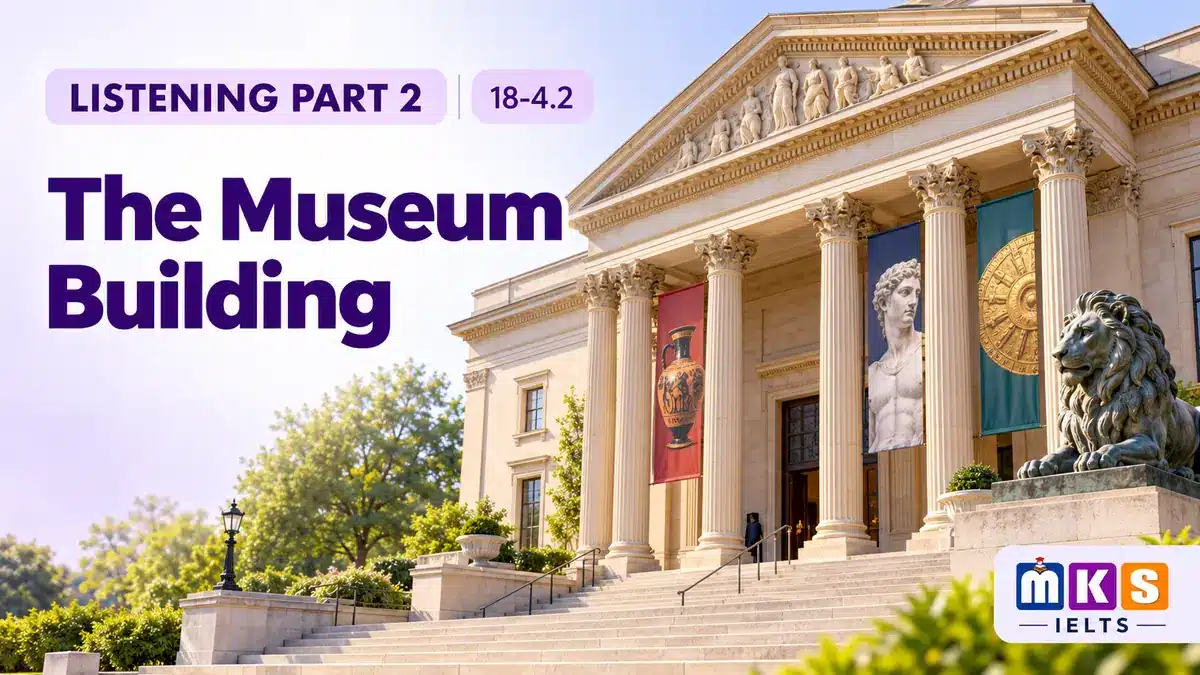
The Museum Building
ANNOUNCER: Part 2, you will hear a guide at a farming museum talking to a group of visitors. First, you have some time to look at questions 11 to 14. Now listen carefully and answer questions 11 to 14.
SPEAKER: Good morning everyone, and welcome to the Museum of Farming Life.
SPEAKER: I understand it’s your first visit here, so I’d like to give you some background information about the museum, and then explain a little about what you can see during your visit.
SPEAKER: So, where we’re standing at the moment is the entrance to a large building. That was constructed in 1880, as the home of a local businessman, Alfred Palmer, of the Palmer Biscuit Factory.
SPEAKER: It was later sold, and became a hall of residence for students in 1911, and a museum in 1951.
SPEAKER: In 2005, a modern extension was built to accommodate the museum’s collections.
SPEAKER: The museum’s owned by the university, and apart from two rooms that are our offices, the university uses the main part of the building.
SPEAKER: You may see students going into the building for lessons, but it’s not open to museum visitors, I’m afraid.
SPEAKER: It’s a shame, because the interior architectural features are outstanding, especially the room that used to be the library.
SPEAKER: Luckily, we’ve managed to keep entry to the museum free.
SPEAKER: This includes access to all the galleries, outdoor areas, and the rooms for special exhibitions.
SPEAKER: We run activities for children and students, such as the Museum Club, for which there’s no charge.
SPEAKER: We do have a donation box just over there, so feel free to give whatever amount you consider appropriate.
SPEAKER: We do have a cloakroom, if you’d like to leave your coats and bags somewhere.
SPEAKER: Unlike other museums, photography is allowed here, so you might like to keep your cameras with you.
SPEAKER: You might be more comfortable not carrying around heavy rucksacks, though keep your coats and jackets on, as it’s quite cold in the museum garden today.
ANNOUNCER: Before you hear the rest of the talk, you have some time to look at questions 15 to 20. Now listen and answer questions 15 to 20.
SPEAKER: I’d like to tell you about the different areas of the museum.
SPEAKER: Just inside and outside the main gallery, we have an area called Four Seasons. Here, you can watch a four-minute animation of a woodland scene.
SPEAKER: It was designed especially for the museum by a group of young people on a film studies course, and it’s beautiful.
SPEAKER: Children absolutely love it, but then so do adults.
SPEAKER: The main gallery’s called Town and Country. It includes a photographic collection of prize-winning sheep and shepherds.
SPEAKER: Leaving Town and Country, you enter Farmhouse Kitchen, which is, well, self-explanatory.
SPEAKER: Here we have the oldest collection of equipment for making butter and cheese in the country.
SPEAKER: And this morning, a specialist cheesemaker will be giving demonstrations of how it’s produced. You may even get to try some.
SPEAKER: After that, you can go in two directions. To the right is a staircase that takes you up to a landing, from where you can look down on the galleries.
SPEAKER: To the left is a room called A Year on the Farm. There is lots of seating here, as sometimes we use the room for school visits, so it’s a good place to stop for a rest.
SPEAKER: If you’re feeling competitive, you can take our memory test, in which you answer questions about things you’ve seen in the museum.
SPEAKER: The next area is called Wagon Walk. This contains farm carts from nearly every part of the country.
SPEAKER: It’s surprising how much regional variation there was.
SPEAKER: Beside the carts are display boards with information about each one.
SPEAKER: The carts are old and fragile, so we ask you to keep your children close to you, and ensure they don’t climb on the carts.
SPEAKER: From Wagon Walk, you can either make your way back to reception, or go out into the garden, or even go back to take another look in the galleries.
SPEAKER: In the far corner of the garden is Bees are Magic, but we’re redeveloping this area, so you can’t visit that at the moment.
SPEAKER: You can still buy our honey in the shop though.
SPEAKER: Finally, there is the pond, which contains all kinds of interesting wildlife.
SPEAKER: There are baby ducks that are only a few days old, as well as tiny frogs.
SPEAKER: The pond isn’t deep, and there is a fence around it, so it’s perfectly safe for children.
ANNOUNCER: That is the end of part 2. You now have 30 seconds to check your answers to part 2.