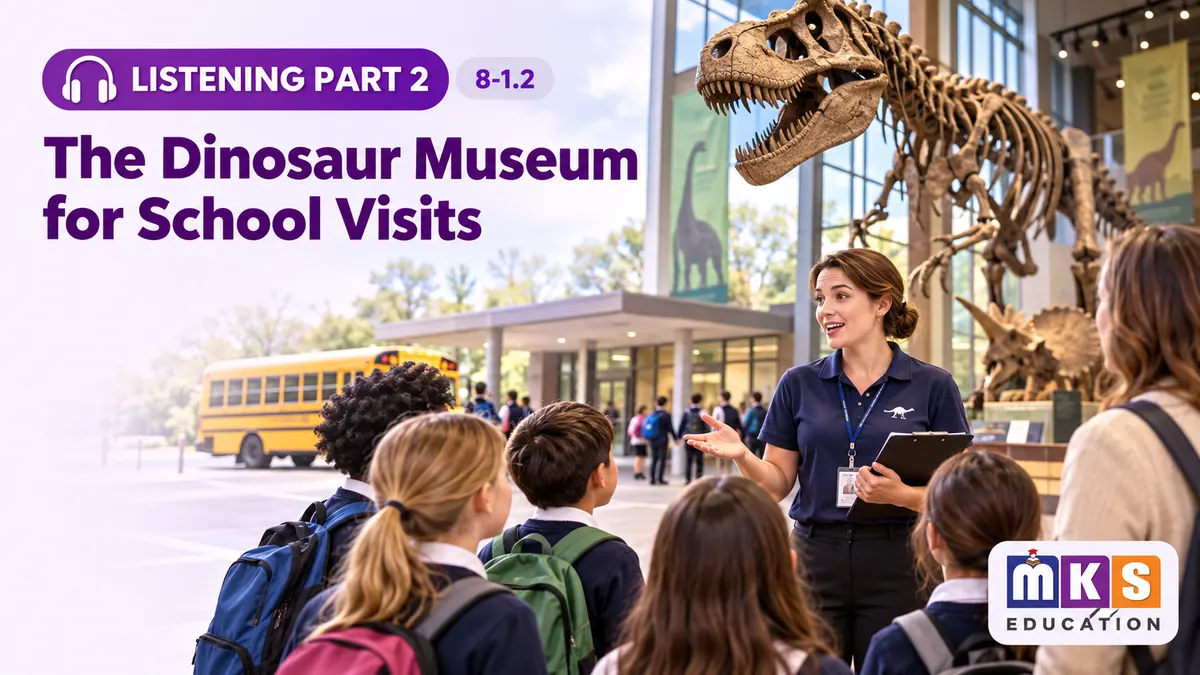
The Dinosaur Museum for School Visits
ANNOUNCER: Section 2. You will hear the education officer of a Dinosaur Museum giving information to teachers who are planning a school visit. First, you have some time to look at questions 11 to 15. Now listen carefully and answer questions 11 to 15.
SPEAKER: Hello, and thank you for inviting me to your teachers' meeting to talk about the Dinosaur Museum and what your students can do there.
SPEAKER: First, let me give you some basic information about the opening hours.
SPEAKER: We are open every day from 9 am to 8 pm, except on Mondays, when we close at 1:30 pm.
SPEAKER: The only day we are completely closed is 25 December.
SPEAKER: Schools can book a guided tour at any time during opening hours.
SPEAKER: When your group arrives, please wait together in the car park.
SPEAKER: A tour guide will meet you there and explain what the tour will include.
SPEAKER: We do this outside because the museum entrance is quite small.
SPEAKER: For a school visit, you should plan at least 90 minutes.
SPEAKER: This includes 15 minutes to get on and off the coach, 45 minutes for the guided tour, and 30 minutes for after-tour activities.
SPEAKER: If students want to have lunch at the museum, you will need extra time.
SPEAKER: There are two cafés inside the museum with seating for 80 people.
SPEAKER: You should reserve seats in advance because the cafés are often crowded.
SPEAKER: Outside at the back of the museum, there are tables where students can eat their packed lunches.
ANNOUNCER: Before you hear the rest of the talk, you have some time to look at questions 16 to 20. Now listen and answer questions 16 to 20.
SPEAKER: When students enter the museum foyer, they must leave their backpacks, books, and lunch boxes in the cloakroom.
SPEAKER: This rule exists because in the past a few items have gone missing.
SPEAKER: Also, some exhibits are fragile, and we want to prevent accidents.
SPEAKER: Students will receive handouts with questions and quizzes.
SPEAKER: They should bring something to write with.
SPEAKER: Students are allowed to take photographs.
SPEAKER: This is helpful for students who are doing school projects.
SPEAKER: However, students must not bring food or drinks into the museum.
SPEAKER: After the tour, students can visit the theatrette on the ground floor.
SPEAKER: There are continuous documentary films about dinosaurs.
SPEAKER: We previously had an activity room where students could make dinosaur models and drawings.
SPEAKER: Unfortunately, the room was damaged in a storm and is currently closed.
SPEAKER: However, we now have an IT center where students can use CD-ROM dinosaur games.
SPEAKER: These games teach students about how dinosaurs found food, protected their habitat, and survived threats.
SPEAKER: That is all the information I have for now.
ANNOUNCER: That is the end of Section 2. You now have half a minute to check your answers.