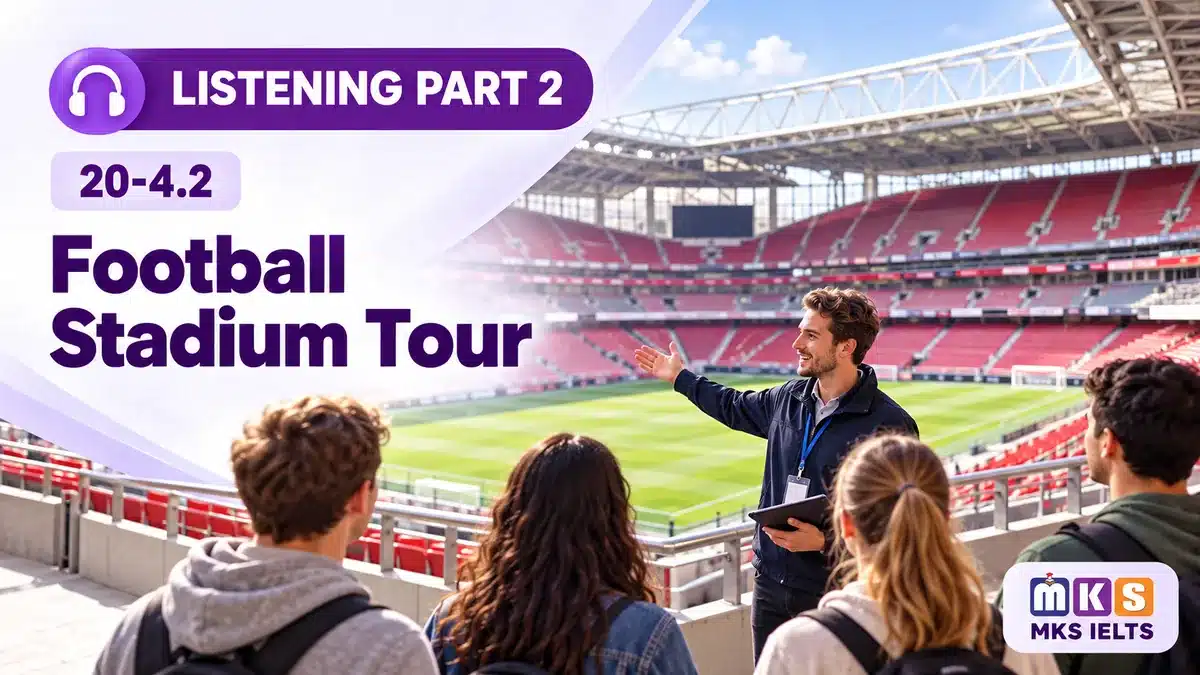
UK Football Stadium Tour and Football History Introduction
ANNOUNCER: Part 2. You will hear a guide talking to members of the public who are visiting a football stadium in the UK. First, you have some time to look at questions 11 to 14. Now listen carefully and answer questions 11 to 14.
SPEAKER: Good morning and welcome to City Football Club. I'd like to give you some useful information about your visit to the stadium today.
SPEAKER: Then we'll start the tour of the areas of the stadium that are open to visitors.
SPEAKER: I can see lots of children here today, so just to let mums and dads know a few things before we start.
SPEAKER: The stadium has lots of stairs, and the players' tunnel is very dark.
SPEAKER: Please don't let your children wander off on their own, even for a minute. We don't want any accidents or anyone getting frightened.
SPEAKER: Cameras are permitted everywhere, and you can take pictures of your child shooting a penalty.
SPEAKER: Assistants are helping to organize this, and hopefully the queue won't be too long.
SPEAKER: It's very hot and sunny out on the pitch today.
SPEAKER: You can get food and drink at the cafe, and I recommend the healthy lunch boxes for children.
SPEAKER: Also in the cafe, children are invited to do a football-themed drawing.
SPEAKER: We'll pick the best one at the end of the afternoon, so don't forget to put your name and contact details on the back.
SPEAKER: If you've left the stadium before then, we'll send your prize, but sadly we can't return drawings.
SPEAKER: I'd like to mention some features of the tour.
SPEAKER: We'll start with the three-sixty cinema experience, which has been very popular over the years.
SPEAKER: Then I'll take you to the players' dressing rooms, before going outside to the seating area and the pitch.
SPEAKER: If you'd prefer your visit to be self-guided, please collect headphones from the reception.
SPEAKER: Then you can listen to the pre-recorded information at your own speed.
SPEAKER: We've only just introduced this feature and would appreciate your feedback.
SPEAKER: We're also thinking of offering tours in other languages in the future.
SPEAKER: If you plan to return another time, you might like to book one of our VIP tours.
SPEAKER: We've only just started offering these, and they can be booked online.
ANNOUNCER: Before you hear the rest of the talk, you have some time to look at questions 15 to 20. Now listen and answer questions 15 to 20.
SPEAKER: The stadium you see today was built in 1989 as part of a three-year redevelopment project.
SPEAKER: During that project the team had to play matches at the ground of another club.
SPEAKER: However, the club has been on this site since 1870.
SPEAKER: That was the beginning of an important decade in the history of football.
SPEAKER: In 1870, teams first started including a player whose job was to guard the goal – the goalkeeper.
SPEAKER: In 1872 and 1873, many new football clubs were established.
SPEAKER: In 1874, referees were allowed to send players off for certain offences.
SPEAKER: Teams also started swapping ends at half-time.
SPEAKER: In early football games the goal was simply to get the ball between two flag posts.
SPEAKER: Later, sticks joined with a piece of tape were used.
SPEAKER: In 1875 that tape was replaced by the solid crossbar.
SPEAKER: In 1877, clubs agreed that a match should last 90 minutes.
SPEAKER: Before that, matches often caused arguments or even fights.
SPEAKER: By 1878, referees began using whistles.
SPEAKER: Electric lamps were also installed on some pitches, allowing evening matches.
SPEAKER: By 1880, clubs started charging fans for admission.
SPEAKER: At that time, players were still amateurs and had other jobs.
SPEAKER: That's very different from modern football, where players earn large sums from both playing and commercial activities.
ANNOUNCER: That is the end of part 2. You now have 30 seconds to check your answers to part two.