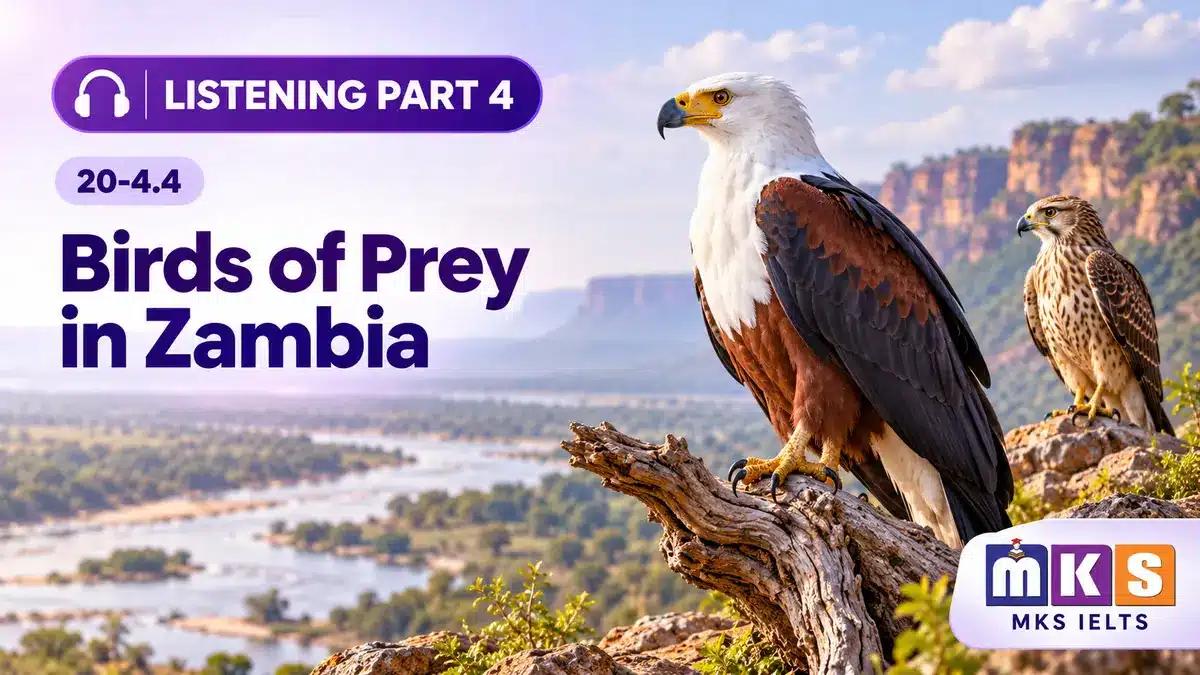
The Impact of Birds of Prey on a Zambian Farming Community
ANNOUNCER: Part 4. You will hear part of an environmental science lecture about the impact of birds of prey on a farming community in Africa. First, you have some time to look at questions 31 to 40. Now listen carefully and answer questions 31 to 40.
SPEAKER: We’ve been looking at different types of conflicts between wildlife and humans that can arise near protected areas such as national parks and animal sanctuaries.
SPEAKER: I’d like to illustrate this with research carried out in Zambia, around the Chembe Bird Sanctuary.
SPEAKER: The sanctuary contains more than 300 species of birds, including birds of prey such as eagles, hawks, and owls.
SPEAKER: These birds survive by hunting and killing other animals.
SPEAKER: Most people living near the sanctuary are small-scale farmers.
SPEAKER: Birds of prey provide important social and ecological benefits for these communities.
SPEAKER: For example, they control rodents such as rats, which damage crops both in the fields and after harvesting.
SPEAKER: Birds of prey also reduce the number of snakes, which are a serious danger to rural workers.
SPEAKER: Local people have long recognized these benefits, even before the sanctuary opened in 1973.
SPEAKER: The birds also play an important role in the culture of the region.
SPEAKER: In recent years, they have become economically important because of tourism.
SPEAKER: Tourism now provides a valuable source of income for local communities.
SPEAKER: However, although birds of prey are protected by law, their numbers are declining.
SPEAKER: Some birds die accidentally when they land on roads to catch prey and are hit by vehicles.
SPEAKER: This is especially dangerous at night, when roads are quieter.
SPEAKER: Birds may also die if they come into contact with high-voltage power lines.
SPEAKER: They may be electrocuted, particularly during heavy rain between December and April.
SPEAKER: Farmers also unintentionally threaten these birds.
SPEAKER: Many farmers keep chickens for food and income.
SPEAKER: Chickens are easy prey for birds of prey.
SPEAKER: As a result, some farmers shoot or poison the birds, even though this is illegal.
SPEAKER: Poisoning is especially dangerous because it can harm the wider ecosystem.
SPEAKER: Some people believe chickens should be kept in areas without vegetation, but this is actually counterproductive.
SPEAKER: Without vegetation, chickens have no cover to hide from predators.
SPEAKER: Keeping chickens indoors permanently would be safer but too expensive for most farmers.
SPEAKER: Many farmers try to scare away birds without harming them.
SPEAKER: Having a dog nearby helps frighten predators.
SPEAKER: During the breeding season, when chicks are vulnerable, children sometimes guard the chickens.
SPEAKER: They make loud noises by hitting pans with metal spoons to drive birds away.
SPEAKER: However, none of these methods is completely effective.
SPEAKER: Farmers therefore use a combination of methods.
SPEAKER: Even so, birds of prey still pose a major threat to chickens and cause economic losses for farmers.
SPEAKER: Because of this, researchers have begun exploring possible long-term solutions.
ANNOUNCER: That is the end of part 4. You now have one minute to check your answers to part 4.